
Solid Metroidvania With Stellar Exploration


Pros
- + Atmospheric world
- + Rewarding exploration
- + Platforming segments
- + Excellent bosses
- + Incorporates mechanics throughout
Cons
- - Confusing story
- - Some battle shortcomings
- - Lack of music tracks
- - Seals/Map/Warp system
Metroid and Castlevania: Symphony of the Night had a huge impact on the gaming industry, essentially spawning the genre of games called Metroidvanias. They have spawned a number of games in the same type throughout the years, including big hitters like Hollow Knight, Silksong, and even Ori and the Blind Forest. There has been quite a bit of a resurgence in Metroidvanias in recent years, ranging from light-hearted ones to adopting the Soulslike genre into the mix. The latter is where a dark-atmosphere game was introduced, called Grime, set in a gritty universe. It was a divisive game, with some people loving it, while others weren’t so hot with some of the designs. Five years after the release of the first one, a second game is on its way to release. Does it clean things up to become better, or is it still in the dirt?
Atmospheric World
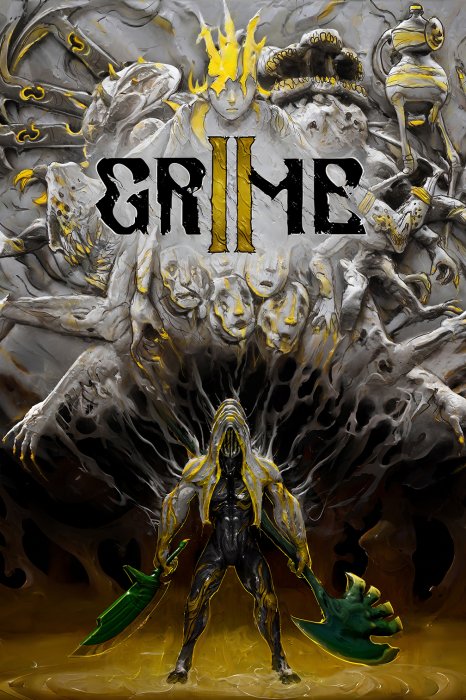
When you first start playing Grime II, you will see that it still has that dark and gritty world to it. The game’s atmosphere is one of the highlights of the game, despite everything seemingly drab and dreary. The whole aesthetic surrounding the game involves paint, hands, and the like, down to the enemies and imagery used throughout. The save points, called Surrogates, are literally just a set of hands, and you will encounter a number of foes, both big and small, that follow similar themes. Not every area has that muddy feeling to it, especially when you look at the backgrounds as you explore. Some regions will have brighter tones, giving a bit more contrast to the darker sections. There is one particular late-game area that is quite beautiful, so there is definitely some work put into the graphical side of things.
The game’s atmosphere is one of the highlights of the game, despite everything seemingly drab and dreary.
Upon starting the game, you are created via some mysterious force, and you don’t really have any clue what is going on in the world. This goes on for a good portion of the game, too, so it can be a little bit confusing, wondering what exactly is going on narratively. Things are more complicated by the fact that the dialogue is puzzling when you do meet the various NPCs you come across while exploring. It isn’t until a good three-quarters through the main story that things start connecting, and you can put some of the story beats together. Even then, the story isn’t exactly anything to write home about and is one of the weaker aspects of this game’s world.

Despite the dark setting, the game is quite atmospheric and lends itself to the world.
The story isn’t the only thing that can be a bit disappointing, as the music isn’t anything to write home about, either. Some of the areas don’t really seem to have much in the way of a melody, opting for more ambient noises going on in the background. Some of the later areas will have some noticeable music, but nothing really stuck with me outside of the game. It’s there and might fit into the game’s world, but you’re not going to be humming or nodding your head along to any of the tracks. On the other hand, the sound effects are fairly nice and fit into the world well. The whole paint theme means that you’ll be hearing a lot of squishy sounds, and they do a great job of conveying the abilities and attacks.
Array of Abilities
Being a Metroidvania, one of the main things I always look for in a game is the movement options. Is the movement fluid, and do the abilities you gain help you navigate the map in a natural way? Grime II does a really fantastic job here, especially once you start unlocking the full repertoire in your character’s arsenal. What starts out as relatively basic things, like a dash and wall jump, extends to more relatively unique abilities, like an ability that allows you to slide up walls. It would have been nice to have a traditional double jump, as so many games of this genre do, but the developers have opted to do something a little different with that.
Platforming in Grime II starts out rather innocently, but once you start unlocking more abilities and getting further into the game, you’re going to start encountering a lot more difficult sections. This is especially true for optional areas that lead to extra items that you can collect. You’ll have to string together wall jumps, dashes, slingshotting with the Grasphook, and much more in these sections. Some of them can get rather difficult, but the challenge can be extremely satisfying once you succeed in the end. However, for those who don’t particularly like platforming, these sections can be a nightmare.
One thing that is a little irksome for navigating the maps is that you won’t have access to a region’s map right away. You’ll have to explore blindly until you happen upon a Seal, which you break to unlock that area’s map. This also extends to the fast travel system, as that’s tied to the Seals, too. When you find the second Seal in an area, you will then be able to warp to any save points unlocked in that region. The second thing can cause some problems, especially if you are having trouble finding the Seals, so you might consider yourself stuck in an area until you find both.

You have to find the two Seals in each area to unlock the map and fast travel.
These abilities not only help you get around the various areas you explore, but they are also pretty well incorporated into battles, as well. While you don’t unlock them at the same time as the ability itself, you do get the chance to use something like the Dash and Grasphook (grapple) in combat. For example, you might be fighting a normal enemy, and they will have a green glow on them, which is your cue to use the Dash to hit them, essentially performing a parry. It’s pretty clear that you’re going to be using a newly learned ability in battles not long after you obtain it.
Moldy Melee
The game adopts the traditional weapon and armor system, although the latter isn’t going to help you tank hits from enemies. You’ll come across some of these as you explore the game’s world, but you might sometimes get a weapon from a boss, plus there are a few places you can even outright purchase them. Each weapon has a speed at which you attack, plainly spelled out to you on the stats page. In addition to normal attacks, each weapon will have a special attack that can be used, some with special properties. For example, there is a scythe you can acquire, whose special attack will not only do damage, but will increase the damage for a short duration for all other attacks. There aren’t only melee weapons, either, as you can obtain some that allow you to attack from range. They give you enough weapons to play around with, which is a nice thing, so you can find something that fits your playstyle.
They give you enough weapons to play around with, which is a nice thing, so you can find something that fits your playstyle.
One weird thing about the equipment system is that armor doesn’t protect you from taking more damage, as there isn’t the traditional Defense stat. Instead, armor will usually provide a boost to one of your primary stats (or two), which don’t really do too much in the grand scheme of things. These stats usually affect a weapon/attack skill, but other than Health and the stat that can affect Parry, the rest don’t seem to have an overarching benefit. The other thing that armors do is provide a bonus, but this will only be if you equip the whole set. Not only are some of these a bit confusing, as you might not know what they do, but there is no incentive at all to equip armor once you start getting full sets.
In addition to your weapons, you will also find extra attacks that you can equip, called Molds. While you can find some during exploration, a number of them can also be obtained from enemies. This will occur as you’re fighting them, and once they reach a certain health threshold, indicated by a little notch on their health bar. Using your Dash on them when they are stunned at that point will not only give you a one-time Mold to use but also increase the counter for learning the same Mold permanently. These Molds use something called Paint, the white dots underneath your health bar, which can be replenished by simply fighting. The Molds you find while exploring are called Item Molds and are represented by a numerical value, which you replenish by simply visiting a save point.

The fighting incorporates a lot of the abilities that you learn throughout the game.
While these Molds can help spruce up the fights somewhat, I never really used too many of them throughout the game, usually sticking to the normal combat. This isn’t a fault of the game, though, but more on my end here, since there will be a lot of opportunities for you to use the Molds.
Like A Boss
You will be doing a lot of fighting, too, as you explore the various locations on the map. The enemies can be hit or miss, though, as some of them aren’t too horrible, while others are just downright an annoyance to try and tackle. One of the biggest problems with a lot of these harder games in recent times is that developers design enemy attacks to have some delays to them. There are a lot of enemies in this game that have weird attacks, either because of their movements or because they just delay them, which leads to you getting hit a lot. This wouldn’t normally be a problem, but your character isn’t the sturdiest, and it only takes a few hits to be defeated, especially once you make it to later stages of the game. Add to the fact that multiple instances will have two or three enemies in a smaller area, and that’s asking for trouble.
Despite that, though, one of the biggest pros for Grime II is the boss fights. There are a large number of bosses, and a good number have been designed extremely well. One boss, for example, wields two hammers and whenever it clangs them together, a symbol will appear over its head. As it continues doing this, these symbols will create full runes that will do things like create shockwaves, or add a damaging area to the field. Of course, you can do things to prevent some of this, like dashing into the boss, as mentioned earlier, whenever you see the opportunity arise. Another example is a boss that, when defeated, will evolve into a new form, complete with new attacks.
There are a large number of bosses, and a good amount have been designed extremely well.
Souls-less Inspiration
There is definitely a good amount of inspiration from Soulslikes here, but Grime II does a few things that help keep players from being as frustrated. Naturally, as you defeat enemies, you will fill up an experience bar, which you can then use to increase your stats at one of the save points. One plus here is that whenever you die, you don’t lose that currency, so there is no need to run back to the spot you died to get your body back. This essentially frees the player from worrying about going through the same area again or fighting the same boss, meaning they can go elsewhere and not have to be stuck.
Additionally, the first game did feature the traditional stamina system one might be accustomed to with Souls games, but that isn’t the case with the sequel. There is still a stamina bar, but it’s not used in the same way. Even when it’s empty, you will be able to dash, attack, and do anything else that uses it. Instead, the stamina bar will have a notch on it, and any attack you do when the bar is to the right of the threshold will deal extra damage. So, you just do extra damage, and while there is an incentive to keep doing that, you’re not beholden to that stamina gauge.

The bosses are well-designed and a highlight of Grime II.
Overall, Grime II is a standard Metroidvania game, with some elements of challenge to it. When you first begin the game, you have the option to choose between two difficulties, Standard and Story. The first is a normal mode, while the lesser difficulty allows you to make the game easier. The only thing that happens with picking the latter is that some achievements are locked, but Story also allows you to toggle damage numbers to be higher/lower, if you want.
The game can feel quite linear, despite being a Metroidvania, but as you unlock more abilities, you can always go back to previous areas to see if anything opens up. There are some bosses that are optional, considering I managed to beat the game and not get the achievement for defeating all bosses. Grime II can also be quite meaty, with a normal playthrough probably taking you about 15-20 hours to get to the ending. If you’re looking to see and do everything, though, then you could be seeing another 10 or so hours added onto that. There are a lot of extra hidden areas to find, and you’ll constantly be checking your map to see if there is anything left to find.
Grime II is a Metroidvania that excels at the whole exploration deal, and while the combat has a few shortcomings, it’s a solid system that plays to its strengths. The lack of having to run back to get your body is something more games that mimic Soulslikes should do, especially in ones where you can easily die. The confusing story and lack of any really excellent music can hurt the game, but the gameplay is where things really matter, and Grime II shines there.
Keep Calm and Paint On
Grime II is a solid Metroidvania that excels where it counts, the exploration, although there are a few nagging issues with some of its combat. It certainly is not without challenge, so those looking for an easy time might want to search elsewhere.
Gameplay:
Sound:
Graphics:
Story:
Value Rating:

No Comments