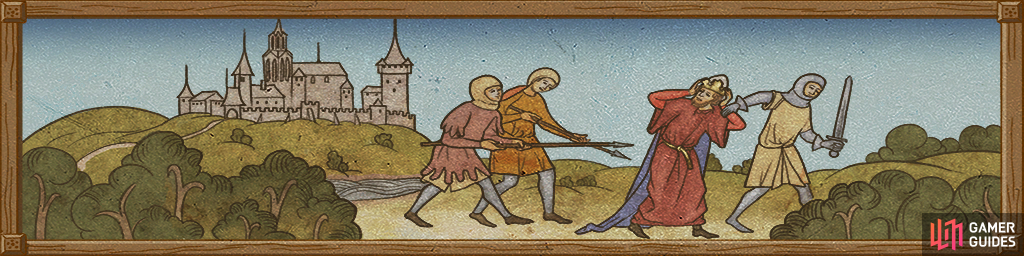
Wenceslas IV was not a very capable ruler. During his reign, he was kidnapped several times in an attempt to remove him from power. The first time he was captured in Königshof near Beroun in 1394 and taken to Wildberg Castle (Upper Austria). In 1402, Wenceslas’ brother, King Sigismund of Hungary, who aspired to the Bohemian throne with the support of the high nobility, imprisoned his brother a second time. Wenceslas was taken to Vienna, from where he managed to escape in November 1403 with the help of allied lords. In the meantime, however, Sigismund managed to impose higher taxes on both towns and monasteries. The towns that refused to submit to him were conquered and plundered. The conflict escalated into a long civil war, which did not subside even after Wenceslas’ death.
In the late middle ages, the world was shaken to its foundations, old certainties were crumbling as new dangers and risks emerged. This crisis was particularly evident in demographic, political and religious (cultural and ideological) spheres. From the mid 14th century, Europe was ravaged by plague epidemics, but the Czech lands were mostly spared. Even before the outbreak of plague, agriculture was experiencing a crisis, as its production was no longer sufficient to feed the growing continental population. The west was ravaged by the Hundred Years’ War between England and France, while in Eastern Europe the Teutonic Order and the Polish state were engaged in a long term conflict in the Baltic region. The Russian state was subjugated by the Mongol rulers of the Golden Horde and further south, the Ottoman Empire, which would later become a traditional enemy of Europe in the early modern period, was growing ever stronger. In addition to these major conflicts, there were numerous peasant uprisings, especially in the west. Universal unity, an important pillar of the medieval world order, was shaken by papal schisms, the long-term inability to resolve this situation, conflicts within the Church itself, and the weakening of the emperor’s position. During the Middle Ages, imperial power, the secular counterpart of universal unity, was limited to rulers over Central Europe, especially the German lands, albeit with varying degrees of real power.
At the turn of the 14th and 15th centuries Moravia was plagued by wars between the brothers Prokop and Jobst of Luxembourg. At issue was the legacy and power of a dynasty that had aspired to the Polish and Hungarian Crowns. After the death of Charles IV, both brothers supported the policies of Hungarian King Sigismund, but when he imprisoned King Wenceslas IV in 1394, Prokop sided with the Bohemian King. In return he was granted the right to occupy episcopal castles which led to his excommunication by the Pope and his subsequent capture by Sigismund.
In 1402, Sigismund again imprisoned Wenceslas IV and tricked Prokop into captivity in Pressburg (Bratislava). That same year, Jobst switched sides from Sigismund to support Albrecht of Austria in Hungary, where an anti-royalist uprising had just begun, aiming for the release of his brother and the Czech king. Prokop gained his freedom through a peace agreement brokered between Sigismund and Jobst, after more than two years of imprisonment. The fraternal conflict between Jobst and Prokop led to anarchy in Moravia, which was exploited by a whole host of robber-barons, who set about attacking castles and villages.
After Prokop’s death, Jobst became the sole ruler of Moravia, and gradually dealt with his cousins. In 1411 Jobst died childless, just as Prokop had done, and the title of Margrave of Moravia reverted to Wenceslas IV.
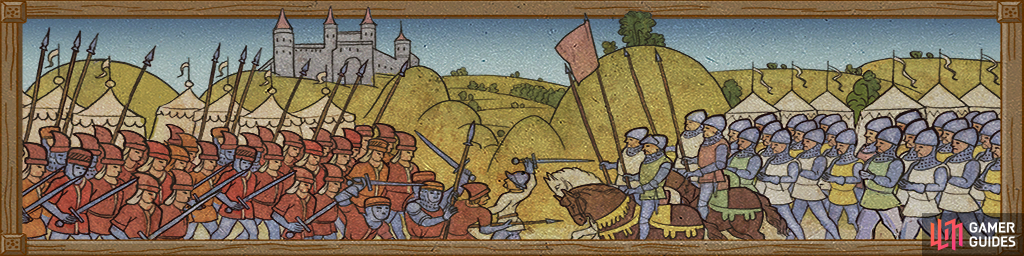
The Battle of Nicopolis took place on 25 September 1396 between the Hungarian king, Sigismund of Luxembourg and the Ottoman Turks, led by Sultan Bayezid. Sigismund’s army was made up of soldiers from France, Burgundy, Germany, England, Italy, Bohemia, Poland and other countries. In total, it numbered between 10 and 15 thousand men. The Ottomans, to whom the Balkans belonged at the end of the 14th century, numbered nearly 20 thousand. The experienced Turkish warriors completely crushed the Christian knights, mainly due to undisciplined French knights who disobeyed orders, they attacked the Turkish vanguard thinking it was the main army, and were subsequently crushed. Those who did not die on the battlefield were brutally executed - reportedly up to 3,000 men. The richest were captured and saved only by ransoms, which they repaid over decades. When news of the defeat reached Paris, no one believed it, and those who initially spread it were sentenced to death by drowning for “spreading lies.” The Ottoman victory was a triumph of Islam over Christianity. Turkish troops posed a real threat to European countries, especially to Hungary.
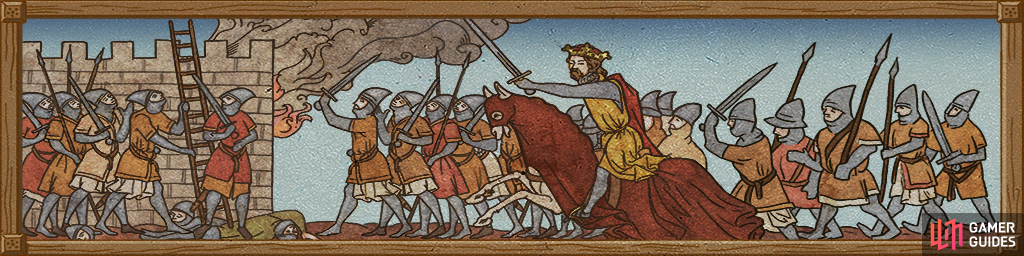
Silver Skalitz is the town which Henry comes from, and which was burned down during the events of the first part of KCD. Regarding the war from 1402 to 1403, when Sigismund invaded Czech territory in an attempt to seize power, little is known or the information is quite uncertain. One of its known victims, however, was Silver Skalitz, which was burned on 23 March 1403. We know the exact date because Sigismund signed a certain document in the siege camp, thanks to which we know he was there that day. Skalitz was undoubtedly chosen by Sigismund because silver was mined there and administered by a supporter of the king, Sir Radzig Kobyla. Sigismund likely wanted to stop the flow of money to the king’s side. Legend has it that Kobyla and his people, who had taken refuge in the castle before the village was attacked, managed to escape because a great storm had begun and the besiegers postponed their attack until morning. The defenders took advantage of this and fled under cover of darkness to nearby Rattay. In the morning, Sigismund’s men found only a goat in the empty castle (as depicted in the game). Sigismund then razed the town and castle to the ground and the castle was never rebuilt afterwards. Today, only foundations remain visible.
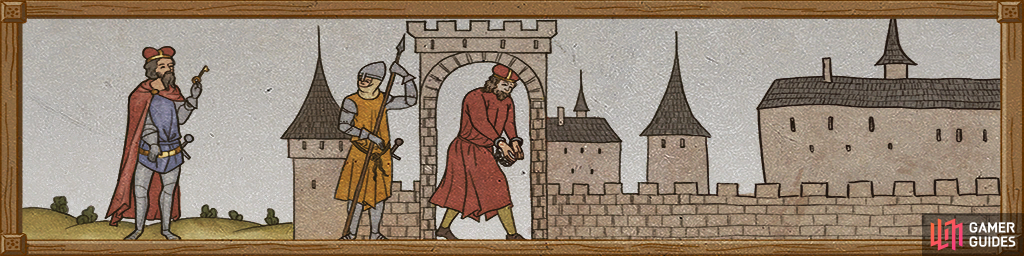
While Wenceslas was imprisoned in Vienna, Sigismund attacked Kuttenberg in December 1402. The city remained loyal to the king, and the miners in particular defended the city tenaciously. When they finally surrendered, they had to follow Sigismund to his camp at Kolin to kneel before him in the mud. Additionally, they had to pay him huge sums of money to prevent the city from being plundered. The surrounding villages were not so lucky and many were looted or burned down. By capturing the city, Sigismund seized the largest silver deposits in the country, which enabled him to continue his campaign. The city’s treasury contained valuable jewels as well as money; all of which fell prey to the enemy. When King Wenceslas IV. returned to the throne, he estimated the wealth seized by Sigismund at one million gold coins of that period. At the time of our game, the city is under Sigismund’s control, though the army itself is camped elsewhere. The top officials and members of the city council have been replaced, but otherwise the city has been left to its own self-government.
When Charles, the young son of John of Luxembourg, inherited the title Margrave of Moravia and subsequently the Bohemian throne, the kingdom began to flourish not only economically but also culturally. This period is now known as “the Golden Age”. During his reign, many cities, towns and castles received new fortifications, new bridges and better infrastructure, as well as new churches. Many famous buildings are named after Charles because he initiated their construction, such as Charles Bridge, Karlstejn Castle and one of the oldest universities in Europe, Charles University in Prague, which he founded in 1348. He also emphasised the role of faith in society. He was instrumental in the renewal of the cults of Saints Wenceslas, Sigismund and Vitus, to whom he dedicated sacred buildings, including the cathedral at Prague Castle. He used marriage policy to strengthen his position in Europe, linking his family with prominent houses in neighbouring countries. He influenced the appointment of ecclesiastical offices. Thanks to his firm rule and a policy based on alliances, he was able to maintain peace in Europe. King Charles was an educated ruler with an interest in the arts, which was reflected in the architecture of the cities, especially Prague, which he chose as the seat of his court and which went through a considerable transformation during his reign.
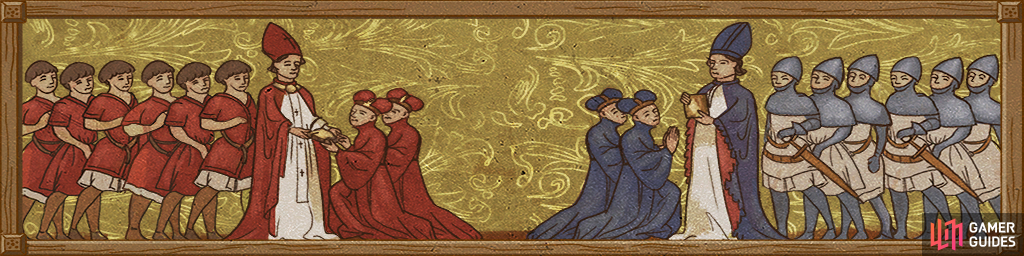
A schism represents a split within the Catholic Church where multiple popes hold office simultaneously. The longest of these began in 1378, when the papal see was moved back to Rome from Avignon, where it had been forcibly relocated for 70 years by the King of France due to disagreements with Roman church officials. However, the new Pope of Rome, Urban VI, refused to share power with the cardinals who had elected him. They therefore declared the election invalid and installed a new, second pope Clement VII, once again based in Avignon. Clement VII was recognised by Scotland, Castile, Aragon, Navarre and Portugal. Germany, Bohemia, England and Ireland, Flanders, Poland, Hungary and Italy sided with Pope Urban VI. After their deaths, Boniface IX took office in Rome and antipope Benedict XIII in Avignon. All attempts to restore the unity of the Catholic Church were unsuccessful. The crisis of faith strongly affected society at the time, and voices of Church critics (such as John Wycliffe and Jan Hus) grew stronger. In 1409, there was even a move by the cardinals to declare both popes invalid and elect a third, John XXIII. However, neither pope was relegated. Only after The Council of Constance (1414-1418), convened by Sigismund of Luxembourg and John XXIII, were there to be reforms in the Church. It resulted in the deposition of all three popes and, in 1417, the election of a new pope, who was based in Rome. The schism was thus brought to an end.