
Return of the Yellow King
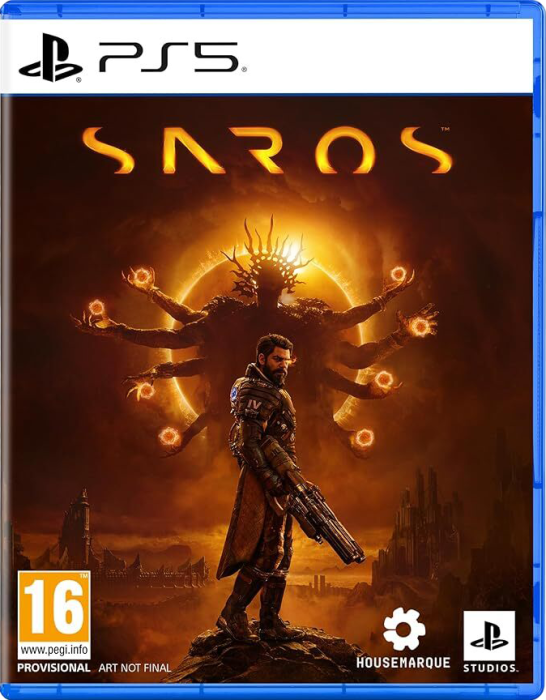


Pros
- + Great gameplay that clearly iterates on Returnal’s design
- + Near-perfect technical performance paired with a beautifully awful world
- + Solid performances from the cast
- + Eminently beatable for most players
Cons
- - Boss fights rarely demand as much skill as you’d expect
- - The narrative doesn’t mesh with gameplay
- - Can’t reach the highs of Returnal's most subversive moments
On the sands of the eternal yellow shore, pain, suffering, enlightenment, and ecstasy are all partial synonyms. Saros has the kind of setup that lends itself perfectly to a brutally punishing roguelike. The idea of an endless, overwhelming bullet-hell inspired by the work of Robert W. Chambers is a combination of gameplay and narrative that feels like a thoughtful iteration on Returnal’s almost mean-spirited meshing of self-inflicted psychological punishment and a type of game that can be theoretically played forever.
While this continued synthesis of gameplay and narrative works on the surface level, Saros rarely integrates its ideas and gameplay as cleanly as its predecessor, leading to an experience where the story and gameplay tell you two very different tales. Saros is at its best when it is posing ideas; however, once they come into practice, much of the sheen comes off. Less of a brilliant yellow, and more of a rusted amber.

Saros looks stunning at times.
The Allure of the Shore
That said, despite its imperfect execution, it’s hard not to be enamored by a game this fun to play. Rarely has 31 hours of play over a long weekend passed so effortlessly. As Arjun — the game’s protagonist played by Midnight Mass and iZombie’s Rahul Kohli - “comes back stronger”, you’ll rarely find yourself not making progress run over run. And while this creates a morish gameplay loop that is akin to “having just one more Pringle”, that constant sense of progress and the relative lack of friction in Arjun’s journey feels deeply at odds with the story’s themes. On one hand, we — Arjun — are trapped in a supposedly endless cycle of brutal self-flagellation and continually inflicting the same suffering onto others that you once experienced yourself. On the other hand, we — the player — are blasting through a linear story with hardly a moment to dwell on the true suffering of the crews of the Echelon I, II, III, and IV.
Progression in Saros is constant; no run is wasted, no upgrade material fails to contribute to either this run being easier or the next run going better. At first, Saros will seem impossibly difficult. Arjun will abandon his crew to explore the reaches of Carcosa, and the relentless onslaught of projectiles and enemies filling the screen will feel overwhelming. Striking him down as a single blue orb takes off a third of his health. However, unlike Returnal, Saros leans much heavier into run-to-run upgrades, skill tree, and all.
…in Saros, you’ll rarely find yourself fighting a boss more than three, maybe four or five times, before beating it.
The skill tree is interesting, as while you have some choice in whether you invest in your suit’s maximum integrity or in the length of time Lucinite stays on the ground, they all get funneled into capstone upgrades gated by defeating an area boss. Ostensibly, these capstones are to prevent you from getting too overpowered in the early game, but in practice, farming out a few runs just for Lucinite to fill out the skill tree would make the boss comically easy.
Pacing is a weird thing; you obviously don’t want to be stuck in a single area for 60% of your time playing a game, but in Saros, you’ll rarely find yourself fighting a boss more than three, maybe four or five times, before beating it. The pattern recognition and flow learning that was demanded of you in Returnal seems to have been sanded down in the name of mostly making sure that you have collected enough Lucinite over the last few runs so that your “proficiency” (your gear’s level that carries over run to run) is high enough to make quick work of a boss.

Saros forces you to keep an eye on what’s going on around you at all times.

You will often need to make choices on the weapons you take with you.
It’s a balancing ethos that I am sure will make Saros much more agreeable for many of those who bounced off Returnal. However, as someone who has been a long-time fan of Housemarque’s arcade sensibilities, it feels like a big step away from the principles that made the challenge of games like Super Stardust HD, Resogun, and Nex Machina so rewarding to master.
Bullet-heaven
The combat of Saros is a smart iteration on Returnal. Actually aiming at your targets is deemphasized compared to Returnal, thanks to a very generous auto-aim. This is so that Housemarque can demand more bullet-hell style maneuvering around hundreds of projectiles and thousands of particles. Housemarque’s adoration for bullet-hell gameplay has rarely been more clearly visible than here, thanks to the addition of an Ikarugian bullet shield.
This shield can be used to absorb blue attacks and charge a much more powerful Carcosan weapon. As you get through the first biome, you will also encounter red attacks that will shatter your shield and drain your Carcosan weapon’s charge, as well as attacks that you can absorb but will cause a buildup of corruption, which lowers your maximum health until you fire off your heavy weapon enough times. These layers are folded in smartly to get you staring at the whole screen, trying to unfocus your eyes so you can properly take in the entire, nightmarish, beautiful chaos that is unfolding in front of you.
It also shouldn’t be understated how good the colorblind accessibility settings here are, giving you full control of the exact shade of projectiles, UI, HUD elements, and more. This flexibility makes it so that you can pretty much always tell what attacks are absorbable, dodgeable, will cause corruption build up, or will always damage you.

The addition of the Shield adds a lot to Saros’ gameplay loop.
Shining like gold
Almost every other part of Saros feels like it has been polished within an inch of its life. Even on a base PS5, it is almost impossible to knock Saros below its 60fps target, an admirable achievement considering how image quality resolves much better than some other Unreal Engine 5 games on the six-year-old console — especially when there are a million colored orbs on screen.
Motion capture and performances from the whole cast are impressive. Although Kohli often elevates the material, the actual characterization of Arjun can be rather one-note. Over the game’s total runtime, we rarely see him as anything other than angry or sad, which certainly makes sense given the circumstances, but can start to feel rather oppressive as you enter hour 20.
Sound design is also excellent, with chunky-sounding future guns enhanced by novel use of the DualSense’s adaptive triggers. The soundtrack is uniformly off-putting and intense, but if anything, I would have loved to see Housemarque lean into its killer audio design more as the game goes on. Nothing quite reached the highs of Returnal’s stellar use of “Don’t Fear The Reaper” — which highlighted what the studio can do with a licensed melody — the closest the game gets is the final boss, which relies on audio cues to fight.

Rahul Kohli delivers an exceptional performance as Arjun.
Returnal of the King
It would be an unfair reduction to simply call “Saros” too easy, because I do think its difficulty curve has been expertly designed to ensure as many people who start the game, roll credits on it too (especially if the trophy percentages already are anything to go by). I know lots of people who never got out of the first or second area of Returnal, so it’s understandable that Housemarque almost certainly wanted more players to see the best bits of its game this go around. However, this leads to Saros’ other major problem. The “best bits” of this game are simply less surprising than those of Returnal.
Returnal has a killer endgame twist. Spoilers for a five-year-old game ahead. After hours of Selene climbing an insurmountable and impossible summit, she finally defeats the game’s final boss. We watch a cutscene of her escaping the torturous planet that trapped her in a loop of death and rebirth. She travels home. Becomes a hero. Lives a long and fulfilling life and dies of old age, peacefully at home with those she loves. But the credits do not roll. She is lowered into the grave, down and down and down, and then, she awakes, on that planet. Again. The loop never ended. She is here forever.
Saros never quite has the same point where everything comes together.
It’s a brilliant moment that signals the halfway point of her journey. From then on out, Returnal’s storytelling becomes much more abstract and metaphorical, as it becomes clear that Selene’s struggle is much less literal than being trapped on the planet. It’s one of my favorite bits of video game storytelling as it exploits the gameplay systems of the roguelike genre so that the narrative can give an emotional gut punch.
Saros plays around with the idea that Arjun’s suffering may be less literal than just being trapped on Carcosa. We see flashbacks or glimpses into his real life that imply he was a real dirtbag — a bad friend and a manipulative partner. These individual story elements work really well to propel you through the game’s 25-ish hour runtime; however, while Returnal’s narrative and gameplay eventually click together into a moment of soul-crushing realization, Housemarque knows it can’t play that trick twice, and Saros never quite has the same point where everything comes together.

While the narrative is interesting, it doesn’t hit the highs of Returnal.
Tarnished but still gold
I should be clear. These seem like harsh criticism and nitpicks because they largely are. Returnal is a game I hold in very high esteem, and comparisons to it are somewhat unfair. There are very few golden strands of reality where Saros could have lived up to what Returnal meant for me. And in some ways, I am kinda glad this game isn’t quite for me in the same way Returnal was. It means it will be for many more people who couldn’t quite jibe with Returnal.
It also means that Saros acts as a fascinating foil to Selene’s story. Where her tale is one of self-isolation and descent into self-loathing, Saros is a story where Arjun’s sins are inflicted on others; he is a much more unlikeable character (helped by Kohli’s steely performance). If anything, Saros’ more forgiving difficulty and Arjun’s eventual decision to accept his awful actions and move on, as he accepts his punishment, act as a pseudo-metacommentary on society’s leniency towards abusive men.
Its faults are largely due to it being a thoughtfully considered iteration on something that felt near perfect to me.
Arjun certainly doesn’t get a “good ending,” nor does Saros imply he should. However, the relative amount of self-reflection and his acceptance of reality is a stark contrast to Selene’s endless torment that sees her trapped in an inward spiral of self-destruction. However, that level of narrative decoding is ultimately just me making too much use of my media studies background.
Saros is a fine game, wrapped in yellow prestige and magnificent horrors. Its faults are largely due to it being a thoughtfully considered iteration on something that felt near perfect to me. While that means that I probably like it a fair deal less than its predecessor, it also means I think other people may like it a fair deal more. Ironically, the one true failing of this king in yellow is that it is so much easier to look at and comprehend, without giving in to its madness.
Saffron Suffering
Saros is a satisfying iteration on Returnal, but its narrative can’t live up to its predecessor’s brilliance.
Gameplay:
Sound:
Graphics:
Story:
Value Rating:

No Comments