
Constance Review

Pros
- + Familiar but beautiful hand-drawn art style
- + Earnest and relatable story
- + A sprawling and varied map
- + Fluid, expressive character movement
- + Great feeling combat
- + Classic Metroidvania formula, executed well
Cons
- - A little formulaic, with few original ideas
- - Some slightly underbaked mechanics
- - The difficulty curve could do with a few tweaks
How on earth do you follow Hollow Knight: Silksong? Btf Games, the Germany-based indie studio best known for sci-fi adventure game Trüberbrook, is attempting to answer that unenviable question with the release of Constance, a Steam exclusive (for now) hand-drawn 2D side-scrolling Metroidvania that wears its bug-based inspirations on its sleeve. Constance is, unmistakably, a Hollow Knight-like. And while it might seem unfair to open this review by referencing the “GTA of indies”, I can’t address the room while ignoring the ten-ton elephant standing in the corner.
Fair or not, it’s in the wake of Silksong that this new game set to launch, looking, sounding, and playing an awful lot like Team Cherry’s internet-breaking mega-sequel. Comparisons are inevitable, but in an attempt to carve its own identity, btf Games have plucked a grab bag of design ideas from other standout titles in the genre before sprinkling some of its own into the mix and giving it all a good stir. They’ve certainly done their homework, and it’s this pick ‘n’ mix approach to a familiar formula that ultimately comes to define Constance.

Honestly, Constance? Same.
Real-World Problems
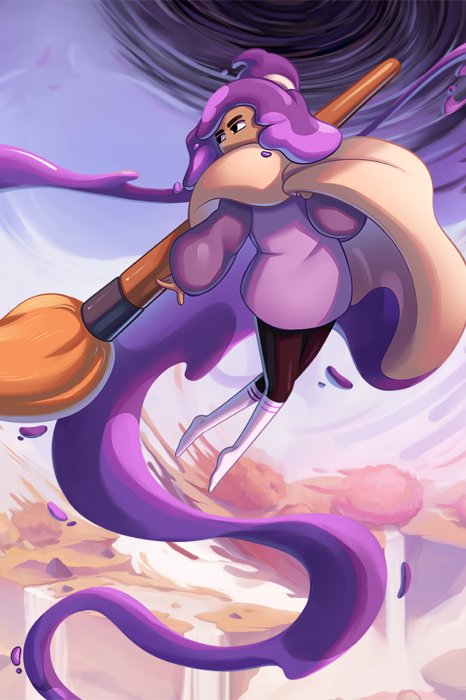
An introductory animated cutscene introduces our purple-haired protagonist, Constance, a young artist suffering from extreme mental burnout. While sitting wearily at her work desk and staring bleary-eyed at her monitor, a flurry of email notifications and chat popups fills the screen and eventually overwhelms her. Constance sinks into the floor, melting into a puddle of paint, and tumbles into a deep, dark void. Mondays, eh?
She awakens in the Inner World - an impossible landscape created from the building blocks of her own psyche. With a few lines of ominous text further hinting at her inner turmoil, you take control. And so begins an exploration of a creative mind overburdened by the pressures of the modern world, and a journey of self-discovery, rest, and recovery. It’s a high-concept but very down-to-earth story, simply told, and is mostly gracious enough to step aside in favor of gameplay.
It’s an earnestly told and well-meaning tale in a game that wears its heart, as well as its inspirations, on its sleeve.
A handful of neat little interactive flashback sequences punctuate key moments, exploring traumatic events from Constance’s life. There’s nothing too heavy here; this is about life’s small stresses and the cumulative effect they have on our ability to cope, and if you’ve spent any time dabbling with the creative arts, you might find the struggles they depict deeply relatable (ahem). It’s an earnestly told and well-meaning tale in a game that wears its heart, as well as its inspirations, on its sleeve.
A Beautiful Mind
There’s no mistaking the source Constance is drawing from for its striking art style. Characters and environments are hand-drawn in a vector-based, 2D style composed with bold, smooth lines and heavy use of layering and parallax scrolling, creating scenes that look beautiful in stills and come alive in motion. It is very Hollow Knight, but Constance uses similar techniques to conjure a much cozier vibe. It has its share of dingy interior spaces, but its warmer tones, pastel hues, and sweeping skyboxes give this game a feel of its own. As much as I like a grimdark aesthetic, it’s nice playing something that isn’t afraid to splash a little color around.
It contributes to a dreamy, inviting atmosphere, supported by an equally light and airy piano and string-focused soundtrack. The dynamic score has enough sweep and scope to heighten the drama at key moments, but otherwise recedes into softer ambient tones more suited to exploration, which, in typical genre fashion, is how you’ll spend the bulk of your playtime.

The Inner World’s six regions are a joy to explore

with a lovely twilight in autumn vibe
The Inner World is a sprawling location comprising six interconnected areas. From the dusky, twilight vibes of Janky Junction - a ramshackle robot town in the midst of a rebellion - to the floating island circus scattered among screen-filling clouds in Chaotic Carnival, they’re all a pleasure to explore. Each has its own visual theme, enemy types (more on combat later), bespoke puzzles and platforming challenges, creating distinctly different experiences in every corner of the world.
The map itself is clean and easy to read, and outside of a handful of essentials, it remains mostly free of markers. It doesn’t hold your hand, and in service of retaining a sense of mystery, rooms are depicted as simple shapes that only vaguely gesture at the real geometry. It can make navigation a bit tricky, but I found the balance to be just about right. In a nice little touch, the screenshot pinning mechanic from last year’s excellent Prince of Persia: The Lost Crown has been replicated here, allowing you to snap an out-of-reach collectible, for example, and pin it to your map to remind you to come back later.
…mysterious locked doors, platforms just out of reach, a pool of water that’s slightly too wide. If you’ve played one of these before, you know the drill.
The game is pretty quick to lift the guardrails, too, and after a brief linear introductory sequence, you’re free to wander. It won’t take long before you start hitting a few roadblocks - mysterious locked doors, platforms just out of reach, a pool of water that’s slightly too wide. If you’ve played one of these before, you know the drill. So off you go, poking and prodding in all directions, hunting down bosses, doing the odd Favor (side quest) for the Inner World’s inhabitants, and crucially, finding new Brush Techniques that unlock previously inaccessible locations.
The first is Paint Dive, a horizontal dash that sees Constance slink into a puddle of paint before popping up, Splatoon-style, on the other side of an enemy or obstacle. Others mostly follow suit - new twists on abilities you’ve seen elsewhere, including Paint Stroke, which lifts the Bash mechanic from Ori and the Blind Forest almost wholesale. It perhaps points to a lack of original ideas - a criticism you could level at the whole production - but it deftly sidesteps a common genre pitfall, where new abilities can be reduced to glorified keys for fancy locks. They all offer utility beyond just unblocking your progress, and the level design makes good use of them, for the most part.
As your bag of tricks and movement tech expands, and the difficulty escalates, the game begins to more closely resemble a gentler Ori, or even Celeste, with lengthy platforming gauntlets that demand complex strings of movement. It never reaches the level of technical challenge as those games, nor the same quality bar, if I’m honest, but it’s not too far off. It feels great in the hands, with super-tight, responsive controls that behave exactly as you expect.
Clonk, Clonk, Clonk!
That same commitment to great game feel extends to combat: a stripped-back affair, with a single weapon and a three-hit combo that remains your best friend from start to finish. Most common enemies have only one or two attacks with well-communicated tells, but they aren’t pushovers and will catch you off guard if you’re not playing cautiously, and there’s a good variety of simple but fun-to-counter movesets.
The combat feels lean, rather than shallow, and a lot of effort has been spent making even the simplest interactions feel as satisfying as possible. Hits have just the right amount of knockback when they connect, the deployment of hitstop and screen shake is pitch-perfect, and a satisfying snap sound on contact with an enemy (or a lovely woody clonk on impact with the environment) makes whacking anything with your brush a strangely moreish sensation. I’d often find myself smacking the walls when I ran out of enemies (don’t judge), it just feels that good.

The platforming can get pretty gnarly at times

and the combat mostly puts up a good fight.
You also find some new toys to play with over time. An early Brush Technique grants a harder-hitting stab that you can freely aim in four directions. Like other abilities, using it consumes Paint, your secondary resource. Draining your Paint meter causes Constance to become temporarily “corrupted”, where further ability usage saps your health. Paint restores quickly with a brief pause, but it’s entirely possible to cause your own death through reckless overuse. It adds a welcome bit of spice to an otherwise simple combat recipe, with a thematically appropriate flourish, even if it is a little on the nose.
Customization comes in the form of Inspirations: a selection of ability modifiers that you, delightfully, slot into your character build like Tetris blocks in a grid. They all offer interesting, tangible benefits, making choosing your loadout a fun, interesting conundrum rather than an annoyance. But it’s the gradually expanding mobility that has the biggest impact on combat. Most notably, the Ori-inspired Paint Stroke, which sees you bursting through enemies with a tap of the left trigger, propelling you out the other side. It really livens up the combat, turning passive wait-and-punish encounters into something far more active and expressive, eventually transforming enemies into yet another traversal aid as you zip through them at blazing speed.
The real highlight of the combat, though (besides the wall smacking, obviously), is the boss fights. After your first encounter with a recycled cube of metal (not sure what they were thinking here), you would be forgiven for lowering your expectations. Stick with it, and you’ll find a varied set of encounters that test you in surprising ways. They mostly follow a similar pattern: a series of escalating platforming challenges as you dodge and weave through screen-filling attacks, followed by a short damage phase, but they will frequently throw things at you (often literally) that you might not expect (bullet hell patterns, anyone?).
…it’s here in the endgame where Constance hits its most compelling rhythm: a punishing technical platformer one minute, and a cozy collectathon the next…
The bosses can be pretty tough, and most took me a few attempts to beat. The combat is never as demanding as the platforming, but both will regularly put you in your place if you’re not paying attention. Death can come fairly quickly, and it’s here that you’ll encounter the Puppet’s Curse system, which presents you with a choice: respawn at the nearest shrine (this world’s bench or bonfire equivalent), or in the room in which you died, but face stronger enemies. A nice idea on paper, but a shrine is never very far away, and there’s no other reward to balance out the risk, making it a little underbaked in practice.
The game has something of an inverse difficulty curve in general, and the sequence at the end of the critical path didn’t have the bite I was hoping for. The closing run of bosses was among the easiest in the game for my powered-up protagonist, and the last stretch was more victory lap than climactic gauntlet. The final boss may as well not have bothered turning up, but I did eventually find some of the escalation I was craving tucked away in optional endgame content. Like many Metroidvanias, the real final boss is a 100% completion rate. It requires you to find every collectible, beat every optional platforming challenge, and complete some pretty obtuse Favors, which will have you scouring every inch of the map, now at your complete mercy.
Watching the completion percentage on the map ticking up and up with each little success is compulsive as ever, and it’s here in the endgame where Constance hits its most compelling rhythm: a punishing technical platformer one minute and a cozy collectathon the next, depending on your mood. Thankfully, there’s a lot of optional meat on the bone, if you’re still hungry. Completing the main story took around eight hours, but I spent a further four mopping things up, and I still have plenty left to find.

A mid-game item displays your completion percentage on the map. The road to 100% is a journey worth taking.
Final Thoughts
If you’re someone who’s played a hundred of these things, you won’t find much here you haven’t seen before, and in borrowing ideas and mechanics so liberally, Constance runs the risk of constantly reminding you of other, better games. But taking successful ideas from other games is one thing; skillfully combining them into a new and meaningful experience is something else entirely.
While it may not do quite enough to carve out a distinct identity of its own, what surprised me about Constance is just how well these component parts have been stitched together into a polished and satisfying whole. If you’re a Metroidvania veteran looking for your next fix, this is a good one, and well worth your time and money. And to answer the question, how do you follow Silksong? The answer, it turns out, is just to make a good video game. And in that sense, btf Games can rest easy.
A Warm Blanket
A slick and polished slice of 2D Metroidvania comfort food that executes well on a familiar formula. A lack of new ideas and a few mechanical stumbles hold it back from reaching the same heights as the classics that inspired it, but it gets close enough to scratch the same itch.
Gameplay:
Sound:
Graphics:
Story:
Value Rating:

No Comments