
Me, Myself, and I’s bad time on Tau Ceti f
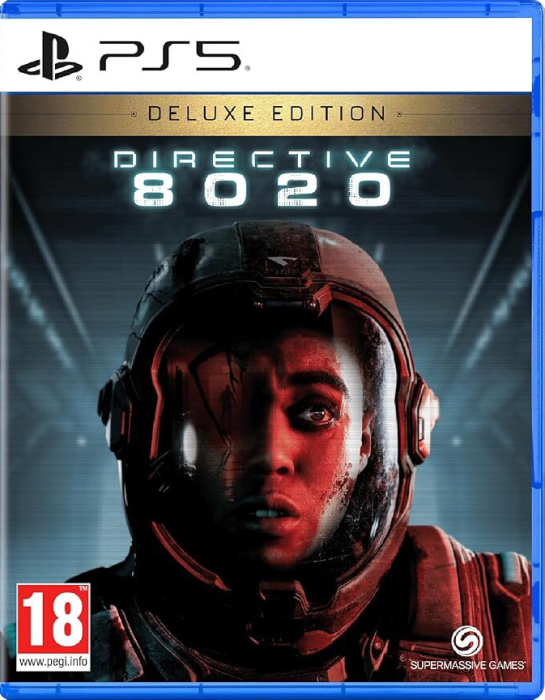


Pros
- + Well-told story with some genuinely solid twists
- + Creepy use of the sci-fi setting and technology
- + Confident cinematic style that toys with the series’ expectations
- + Much more likeable characters than previous games
Cons
- - Third-person exploration is mostly just to change up the pacing
- - Some Dark Pictures fans will be disappointed in the relative lack of The Curator
- - Replaying large chunks of the game won’t be for everyone
- - The game’s performance leaves something to be desired
One of my favorite things about the horror genre is the breadth of ground it can cover. From creepy mansions to campground slashers, and from commentaries on the American military-industrial complex to whatever is going on with old gods in Dead by Daylight these days, Supermassive’s strength as a developer has always been the variety of its releases within its now traditional choice-driven structure. The constantly shifting tones and subgenres of Supermassive’s releases are something that embodies the culture of horror filmmaking. However, up to this point, the Guildford-based studio has been bound by one ever-present constraint: Earth.
It is somewhat surprising that despite the release of five Dark Pictures games, Until Dawn and its three pseudo spin-offs, and the Bandai Namco-published standalone release The Quarry, the company had never touched sci-fi horror. It makes sense, though — it’s one thing for your game to be compared to campy but fun gore-fests like Friday the 13th or Cabin in the Woods, but expectations change a lot when the two closest points of comparison are films preserved in the Library of Congress: Alien and The Thing. That’s why I am pretty delighted that, despite several delays and two large rounds of layoffs, Directive 8020 does just enough to stand on its own as an enjoyable romp through a doomed mission to Tau Ceti f.

Directive 8020’s setting is a fresh new direction for the Dark Pictures games.
Who are you, really?
The setup of Directive 8020 is rather straightforward. Earth is doomed. Astronauts are being sent to scout a potential new planet with a colony ship following six months behind. Something crashes into the forward mission while most of the crew are still asleep, and now we have The Thing in space. It’s not exactly the most original setup, but where Directive 8020 shines is in the moments that it plays into and toys with expectations and the audience’s presumed knowledge of the genre.
Directive 8020 does a good job at exploiting the future setting in ways that its inspirations couldn’t.
This takes two forms. Moment-to-moment tension building that is surprisingly effective, and large narrative swings that exploit genre conventions. John Carpenter’s The Thing is basically a perfect movie, so the first three chapters of the game, where the crew isn’t sure just what is happening on the ship, fall a little flat in comparison. However, once the knowledge that there are potential shapeshifters aboard comes into play, Directive 8020 does a good job at exploiting the future setting in ways that its inspirations couldn’t. A simple mechanic is the fact that all these characters have wrist straps with in-built communicators, which you can open at pretty much any time the game gives you full control of the character. This allows you to DM back and forth with other crew members to share info that might prevent you from doing something foolish or can add another layer of doubt when stories don’t line up.
Sometimes in the Dark Pictures games, you will be given a choice like “there is a scary sound behind this door, shoot at it or don’t,” and it may as well be a dice roll as to whether another character is behind that door or a monster. Several times in 8020, I found myself keeping a mental inventory of what parts of the ship I last played as a character or heard from them. This is then made creepier when communications seem off, and it’s up to you to figure out if these people are just freaking out because of their situation or if something more nefarious is going on.

The cast of the Cassiopeia are an interesting bunch.

You’ll have to make some difficult decisions throughout the narrative.
Twisty turny
The other big thing that makes Directive 8020 is its big narrative swing. It’s a plot twist that I am not going to spoil (mostly because it’s embargoed), but basically, partway through the game, the genre of horror shifts to something more metatextual that plays into the choice-driven nature of the game in a neat way.
As always, with these games, the connective tissue isn’t always as clear as in more linear narratives. The flowchart you can access in the pause menu does a good job of simplifying things, but these games are pretty complex webs of branching narrative. Certain bits of information key to piecing the grander narrative together will require a second play-through or loading up an earlier decision. However, the experience of going back and gathering this info is much easier and more rewarding in 8020 than in previous Dark Pictures games.
Playing the default, recommended mode for your first play-through, you can reload the game to virtually any decision, be a minor dialogue choice or one of the more impactful “turning points.” This means, without starting a new game, you see the butterfly effect of your decisions play out, with the game’s flowchart showing you which narrative branch you are currently on and hints as to which previous decisions could lead you down a different path.
This system is by far the most robust in a Supermassive game; however, that’s not to say it trivializes getting a “perfect run” where no one dies.
This system is by far the most robust in a Supermassive game; however, that’s not to say it trivializes getting a “perfect run” where no one dies. Some decisions made early on have big impacts, including multiple dialogue choices shaping a character’s personality when you are not in control. So, if someone dies at the beginning of, say, Chapter 4, you might need to load all the way back to Chapter 2 to prevent it, and you do have to play through the rest of the segments again, even if there are no other changes in what you did. It’s a somewhat inelegant solution to a near-unsolvable problem, but in practice, it’s something that will only become annoying if you do want to see literally every possible outcome to the Cassiopeia’s mission.

Directive 8020 features a turning points system, allowing you to go back to past decisions.
Performance and performances
Directive 8020’s longer development time was something that had me worried, especially since game director Will Doyle has talked in the past about the shift to a new engine (Unreal Engine 5). However, this larger gap between releases has mostly paid off. 8020 feels noticeably more cinematic than The Devil in Me did, with a lot more considered direction and little flourishes in the camerawork, creating some creative shots and movement within the confines of the ever more claustrophobic ship. This can be seen in the pacing, too, which feels way less rushed than most Dark Pictures games, putting it on par with Until Dawn or The Quarry.
One of the strongest aspects of this longer runtime is how it gives the game’s meatbags much time to develop into actual characters worth caring for. This is also helped by the fact that, instead of the purposefully unlikable teenage fodder in Until Dawn or The Quarry, the crew of the Cassiopeia is, by and large, competent and professional.
Another bonus (for me at least) is Directive 8020’s self-assured confidence to stand on its own.
While Lashana Lynch playing one of the ship’s pilots is the most well-known bit of casting, I found Cernan’s portrayal by Philip Arditti and Jermaine Dominique (in voice and motion capture, respectively) the most affecting. What starts out as a puppydog-like naive optimist winds up having some of the most interesting layers surrounding his faith and grief, should he live long enough to discover the game’s big twist. It’s the kind of characterization that the game could have done with a lot more, and one that engages with the game’s sci-fi concepts in a surprisingly thoughtful way.
Another bonus (for me at least) is Directive 8020’s self-assured confidence to stand on its own. The Dark Pictures branding has always felt vestigial at best, with the connections between games rarely amounting to much. 8020 seems to know that, fully forgoing any references to the wider series until an optional discovery in the final chapter. Some of this may be down to the tragic passing of The Curator’s face model, Tony Pankhurst, but it largely feels like this decision was made as the game does enough to stand on its own without reliance on an overarching inter-game lore.

The exploration serves to change up the pacing a bit.

You can open up your wrist strap at any time for vital information.
One noticeable downside to the game is performance. While the game looks great, and the motion capture is excellent, Unreal Engine 5 is, at this point, notoriously heavy. And in the run-up to release, flagship graphical features like raytracing and pathtracing, which certainly add to the atmosphere, slash performance running on even a relatively new and high-end gaming PC. What’s more, these features also caused crashes if turned on for too long; however, that was noted in the embargo as something that should be fixed by release.
What wasn’t noted was a nasty visual bug that I spent my first half hour with the game trying to troubleshoot, where all of the 3D rendered graphics simply did not appear. At first, I thought the blank screen with nothing but bold white font credits was a strange homage to early Friday the 13th intros, but it seems like it was actually down to the ray-tracing being turned on. Eventually, I found out I could still use these features if I got past the first cutscene with them turned off, but with raytracing slashing performance by about 60% on my 5070 Ti and Ryzen 7 7700x, I quickly turned those features off fully.
Getting Directive 8020 to run on your PC may be a bit of a “taming the beast” situation, as is the case with many UE5 games. However, it’s an unfortunate ding against a cinematic experience that, in an ideal world, you really want to just set and forget.
What kind of “you” are “you”?
Directive 8020 isn’t perfect. The nature of its branching narratives means occasionally shots don’t cut together exactly how you’d expect (especially if a key character has died). The 3rd person exploration is less of a redefinition of what these games are and more a novel way to break up the pace. And the game’s performance on PC needs some work. However, despite its flaws, it’s hard not to be enamored by the game.
…a game that gets very close to the breakout highs of Until Dawn.
It feels much bigger than any previous Dark Pictures game, but thankfully, it also feels much more complete. Stronger characterizations in places help, but the real key is that the doomed journey is just a really engaging romp. A thoughtful focus on the cinematic aspects of the series that work, paired with some fun twists, has resulted in a game that gets very close to the breakout highs of Until Dawn. If the future of The Dark Pictures is less frequent releases with more to say, that seems to have gotten off to a pretty good start.
Confident
While Directive 8020 exhibits some of the frequent shortcomings of previous Dark Pictures games, it is a largely enjoyable sci-fi, horror jaunt to the other side of the galaxy. With confident direction and surprising twists its a high watermark for the anthology series.
Gameplay:
Sound:
Graphics:
Story:
Value Rating:
Best offers compared for Directive 8020
| Retailer | Product | Price | Action |
|---|---|---|---|

|
 PC
Steam Standard Edition
PC
Steam Standard Edition
|
Best price $33.49 $49.99 Save $16.50 33% | Buy at Fanatical |
|
|
 PC
Steam Digital Deluxe
PC
Steam Digital Deluxe
|
$40.19 $59.99 Save $19.80 33% | Buy at Fanatical |

|
 PC
Steam Standard Edition
PC
Steam Standard Edition
|
$40.99 $49.99 Save $9.00 18% | Buy at Green Man Gaming |
|
|
 PC
Steam Deluxe Edition
PC
Steam Deluxe Edition
|
$49.19 $59.99 Save $10.80 18% | Buy at Green Man Gaming |


Prices come from our retail partners. We may earn a commission when you buy through these links, which never changes the price you pay or the order offers appear in. How this works
How offers are ranked
Offers are ranked by price, not by the commission Gamer Guides receives.
Cheapest confirmed price first. Offers we can confirm are in stock come before offers whose availability is uncertain, and any offer without a current price sits at the bottom.
Prices exclude delivery unless a retailer states otherwise, so the cheapest listed price is not always the cheapest delivered price. Prices and availability change, and a price we cannot re-verify is hidden rather than shown as though it were current.
Retailers checked: Fanatical, Green Man Gaming, Amazon, ShopTo, Ubisoft Store. No applicable offer from Amazon, ShopTo, Ubisoft Store.

No Comments