
A Remake Worthy of the Dragon Quest Name


Pros
- + Pacing is much improved over previous versions
- + Discovering the effects of time-hopping is delightful
- + The turn-based combat—especially on Hard—is as fun as ever
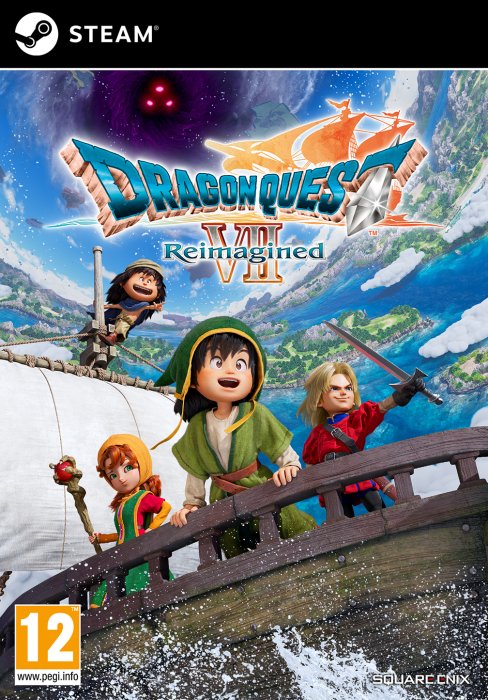
- + Dragon Quest has never looked better
Cons
- - It still takes a bit too long to unlock job changing and the final companions
- - Likewise, the middle part of the game is still a bit of a slog
- - Kiefer and Maribel aren’t the most affable party members
As a massive Dragon Quest fan, I have a confession to make: I think the original Dragon Quest VII is an objectively bad game. Endless fluff, especially in the game’s opening hours, made it an absolute chore to play. My first experience with VII left such a bad taste in my mouth that I didn’t even enjoy a brief attempt to play the 2016 remake despite much better pacing and quality-of-life changes.
Enough time has passed since then that I began looking forward to another go with Dragon Quest VII: Reimagined after its announcement. With promises like a further streamlined story, reworked battle and job mechanics, a fully orchestrated soundtrack, and a striking new visual style, I had high hopes that they’d finally given this seventh entry enough Oomph to keep me interested in seeing the credits roll.
And it did just that. While I wouldn’t go so far as to say that Dragon Quest VII: Reimagined is now up there with Dragon Quest III, VIII, and XI for my favorite in the series, it gets damn close with all the positive changes developers Square Enix and HexaDrive have made.

Dragon Quest VII Reimagined is the best the series has ever looked.
Time-Hopping Shenanigans
Like in the original, Reimagined stars a trio of young adventurers who are fed up with their solitary island life; you see, there’s no other island in the world other than the one the game begins on, and they’re determined to set sail and find other people and cultures. Instead, they discover fragments of maps that, when correctly arranged in a mysterious shrine, teleport them back in time to islands that differ from theirs. Upon solving a monster-related problem on these myriad islands, they return to their own time to discover that a present-day version of those islands has appeared within sight of their own.
This setup—a departure from the more traditional continental quests of other Dragon Quests—is one of Reimagined’s strengths. The developers cut a fair share of droll puzzles and turned some regions into optional sidequests, allowing you to see the past and present changes of these islands more quickly, which is always a delight.

It’s a joy to solve mysteries in the past and see how it affects the present.

This often leads to new fragments that allow you to access even more islands.
After saving a village from a curse that turned all their residents into animals and all the animals into humans, I couldn’t wait to hop in my ship in the present to find out how that village had changed over an indeterminate number of years. There, I learned that the town had developed a little animal cosplay festival in honor of the heroes who saved them from their fate.
…returning to the present to see what happened to the characters that starred in it was a treat that kept each gameplay session rolling for much longer than I had planned.
Shortly after that, my band was off to battle a mechanical horde assailing a desperate kingdom. While the story contained on that island wasn’t the most memorable, returning to the present to see what happened to the characters that starred in it was a treat that kept each gameplay session rolling for much longer than I had planned.
Colorful Companions, For Better or Worse
The story isn’t all sunshine and friendly Healslimes, however. I still found the two starting companions, Kiefer and Maribel, abrasive to adventure with. While the former grew on me as he has an expanded role in this version, the latter annoyed me from beginning to end with the haughty, bratty attitude she uses to hide her true feelings.
Later companions—such as Ruff the wolf-cub-turned-human—were as expressive and delightful as you’d expect from a Dragon Quest game, though the final two don’t join until after about 20 hours of gameplay. Still, I largely enjoyed traipsing through time with this cast as the individual tales told within each region were packed full of Dragon Quest charm that did more than enough to keep me entertained while I solved the less interesting overarching plot to stop the Demon King.

Some of the cast members can take a while to warm up to.
Much like how you don’t unlock the final two party members after a bit too long, the option to change classes doesn’t happen for about the same amount of time. What’s more, the new addition of Moonlighting—which lets you equip two jobs at once—doesn’t become available for another five or six hours after that.
…despite the developers axing plenty of forgettable puzzles and turning some regions of the game into optional content, there’s still plenty of awkward pacing in Reimagined
As such, despite the developers axing plenty of forgettable puzzles and turning some regions of the game into optional content, there’s still plenty of awkward pacing in Reimagined. It doesn’t feel like the game gets going until about that 20th hour after an absolute slog of a section that sees your party sapped of all their powers, which also sapped the turn-based battles of their strategy.
Despite this, I still had more than enough motivation to play, but I could see some players losing interest as they max out their starting jobs and grow tired of this section and of the same three companions for a large chunk of the adventure.
Turn-Based Delights
Thankfully, the turn-based combat is better than ever here when you do have your abilities, especially on the harder difficulty settings. Without excessive grinding, bosses and optional challenges put up a huge fight this time around, forcing me to adopt unique strategies that relied on the powers of equippable Monster Hearts and the new Let Loose abilities tied to specific jobs. When a companion uses Let Loose, they enter an amped-up state that provides them with tons of bonuses like nullifying attacks, the ability to bypass elemental resistances, or summon a horde of sheep to assist in battle.
Early on, I equipped the Golem Heart on Maribel to have her survive a killing blow with 1 HP, as she was by far the squishiest party member. I also equipped the Clawcerer Heart on her to vastly increase her Critical damage when she Let Loose as the Mage class, which guaranteed critical hits. On the harder difficulty settings, combining jobs and Monster Hearts to make the most broken builds possible was a satisfying necessity to overcome some truly challenging bouts through to the end.

The turn-based combat is fantastic.

While the animation and design of your enemies are always a joy to behold.
The updated graphics and orchestral score also helped carry me through the sluggish middle. Much like how the HD-2D style revitalized the first three Dragon Quests in their respective remakes, Reimagined adopts a handcrafted diorama style that superbly fits the whimsical nature of the series. Character models and the iconic monsters benefit the most here, bringing to life Slimes, Hammerhoods, Sabercats, and dozens more like never before.
I did wish the environment reflected this diorama-style more, however. Reimagined is kind of the opposite of FANTASIAN Neo Dimension, which saw handcrafted environments that 3D characters explored; as it stands, the various islands you visit do have more of a traditional 3D look to them, with light diorama-esque touches where the characters look more like dolls. Though this is a small, personal gripe, I wish the developers had gone the extra distance to make Reimagined feel like a truly handcrafted adventure. Even then, this is without a doubt the best the series has ever looked.
Simply Subslime
With Reimagined, it feels like Dragon Quest VII is largely free of the oppressive pacing of its previous versions and almost joins its brethren as one of the best in the series. As such, it’s a worthy adventure for fans of turn-based games and Dragon Quest alike.
Gameplay:
Sound:
Graphics:
Story:
Value Rating:

No Comments