
Marathon’s Balancing Undermines Incredible Fundamentals


Pros
- + A stunning world and an intriguing universe
- + Punchy gunplay and fun Runner Shells
- + Incredible soundtrack and tone
Cons
- - The world, music, and story are rarely given a chance to breathe by the nature of the Extraction Shooter genre
- - PvP-focused contracts and balancing have already trained the community into being hyper-aggressive
- - thus, making it way less likely you’ll come away from the game with “fun stories” or interactions
Over the last four-ish days, I have put a bit over 25 hours into Marathon — this is in addition to 18 or so hours I put into the “Server Slam” in the days leading up to launch — and yet I still feel like I barely know the game. Some of this, admittedly, comes from trying to speedrun my way to getting up to date with what might be one of the densest lores Bungie has ever developed, including cyber-gods, potentially divine gods, and the Clinton administration. However, the other reason I feel like I don’t really know Marathon is that it seems to be pulling itself in a myriad of different directions.

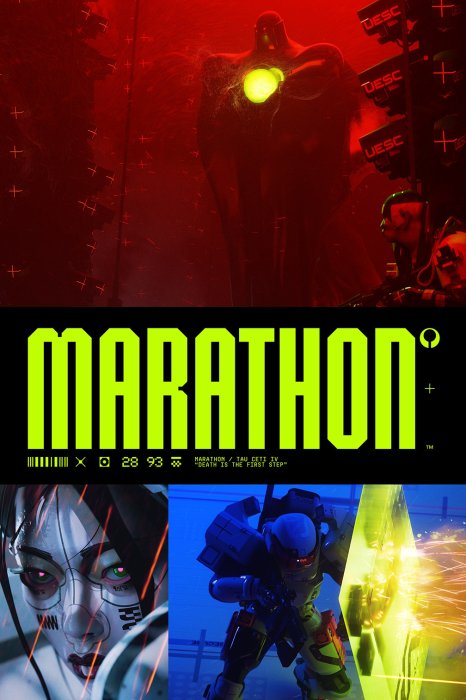
Marathon’s art style is a sight to behold.
A World That Doesn’t Want You
Before I really get into the weeds here, because discussing this kind of game means really digging into the minutiae of balancing and how the game directs player behavior, I want to make it clear: I like Marathon… At least I think I do. Marathon is one of the most visually arresting triple-A games released in the modern era, with art direction so bold and aggressively singular that the idea that it came from a publisher like Sony feels kind of shocking. We don’t get games of this scale and this budget that look this unique anymore.
Special mention has to go to the material effects of virtually every surface. From rain-covered stones to the meshing of hard metals meeting soft (3D printed-looking) plastics, Marathon’s world has an incredibly tangible look to it. It is almost the polar opposite of launch Destiny’s space opera-inspired world of cloaks and fine metals, or Halo’s industrial military complex-fueled heavy machinery and bulk.

Marathon has a distinct style that can be seen in everything.

Such as the material effects of virtually every surface.
The failed colonies of Tau Ceti feel cheap; rushed prefabs launched into space and quickly assembled on the ground of a foreign planet for maximum efficiency litter lands that clearly don’t want them there and are winning the battle to rebuff terraforming efforts. Runner shells feel mass-produced and fragile, designed for optimum return on investments, should they bring back any valuable goods for the companies combing the wreckage of this failed voyage. Each can be adjusted with marginal customization to create a minor feeling of individuality among the once-human consciousnesses that inhabit and are doomed to die in them over and over.
Punch, Grunt, and Style
The act of shooting in Marathon is supremely satisfying in a way that only Bungie shooters tend to be. The heft and kick of a wide array of weapons make basically every gun feel punchy and dangerous when paired with sound design that makes these plastic guns sound like they are going to blow apart in your hands.
The heft and kick of a wide array of weapons make basically every gun feel punchy and dangerous
These guns are wielded by six main Runner Shells. Each shell has a specialized toolkit focused on different playstyles. The Destroyer is a heavy class that can provide a protective shield, and his loadout can be almost directly mapped back to several Titan subclass abilities or exotic bonuses from both Destiny games. The Assassin’s smokescreen and active camo have quickly become a favorite for high-level play, with its abilities making for great aggressive play. The Recon has maybe my favorite character design, paired with a helpful if somewhat standard “ping enemies” ability. The Triage’s healing drone is extremely potent when playing with friends or communicating with randos. I haven’t really gotten to grips with the Thief’s abilities as well as I’d like, but her grapple works nearly identically to Destiny’s Strand Grapple. Lastly, the Vandal has been my favorite to play solo, with plenty of movement abilities, including an extra-powerful crouch slide that makes her one of the few Shells capable of escaping if another team gets the drop on you.

All of the Runner Shells feel distinct, even if the cosmetic options are a bit lacking right now.
These shells all feel really good to move around with, even if stamina (or “Heat” as the game calls it) management feels a bit limiting to start. While the game currently has the lowest number of skins or customizability it will ever have in its lifespan, there are already some alternative skins. Some of these simple palette swaps are usually unlocked by completing character-specific challenges found in your codex. While ones on the first battle pass, launched alongside the game, are slightly flashier but are ultimately also palette swaps. While these skins look great, and manage to keep the game’s strong sense of style coherent, they do feel a little unvaried — this is especially true for the handful of skins that can only be purchased with real money, which are much brighter and bolder, but again really don’t have much in the way of unique personality when they are going for $15 a pop.
Escape Will Make Me God
The narrative of the original Marathon games has long been lauded by a small but passionate group of players who either played those games when they first came to Mac in the mid 90s, or went through the hoops of emulating them on modern machines before Bungie and Aleph One Developers ported the original trilogy to modern PC in 2024. It’s a heady and dense, hard sci-fi world that is intentionally vague in places to the point that fan communities can still be found debating some of Durandal’s codex entries decades later.
So far, the storytelling for 2026’s Marathon has been equally oblique in a much more modern way. A stunning short film and vibey music video have given us the best — if rather narrow — looks into the current state of the universe in Marathon. The game itself, though, is home to an extensive codex that slowly unlocks as you complete challenges and objectives. This codex (from what I have unlocked so far) is well written, but feels a little at odds with the game it inhabits.

Despite the fantastic lore in Marathon, a lot of it is delivered outside of the main gameplay.
It’s not like I am going to stop after a run with my two friends in a voice call to read a 10-paragraph-long block of text, no matter how interesting it is. This means that a lot of the narratives that players are picking up on are coming from retellings through other community members on YouTube or Reddit via Lore Videos or quick explainers. This obviously is nothing new for Destiny players who practically look to content creators like My Name Is Byf as de facto canon keepers for Bungie games. However, it does feel a little strange to launch a game with such a deep and interesting world, where so little of that information surfaced for casual players — especially when a lot of it is really cool.
Bungie has already started teasing the return of fan-favorite god-like AI Durandal, both in-game and through an ARG. However, even with that, I really hope that as the world and story of Marathon evolves, more steps are taken to fold the narrative into the act of playing Marathon, instead of sidelining it to extracurricular studies.
Why Are We Here?
Marathon is an extraction shooter, a term that has gained popularity and notoriety through player vs Player games like Tarkov, Hunt Showdown, and most recently Arc Raiders. While Marathon’s art direction and world design feel incredibly focused, the actual gameplay of Marathon is a bit of a jumble of traditional PvP concepts and battle royale ideas, while ostensibly also facilitating peaceful solutions. The problem is that nonviolence is virtually never “the best option.”
The loop of these games sees several teams drop into areas full of AI enemies and force them to race to scavenge the same resources while completing contracts, which level up factions that then unlock new loot, which can be brought on runs. All this equipment can be lost if you fail to extract; however, in Marathon, a lot of these contracts can be completed even if you don’t make it out alive. A lot of these games’ draw is the systemic and diegetic stories that players can tell through unpredictable interactions with other humans. Even if you are all technically fighting over the same map full of gear, usually, death is so punishing that encountering a human causes a moment’s hesitation. Would you be better off starting a fight and risking all your gear, or trying to peacefully avoid conflict or negotiate peace? The problem is that Marathon is currently balanced and designed in such a way that this moment of hesitation virtually never occurs.

You’ll need to coordinate with your Crew to have a chance of extracting with your loot.

This can be difficult when most of the playerbase shoot first, ask questions later.
Ask Questions Later
There are several reasons for this. Firstly, XP earned for killing players carries over in death, meaning even if you don’t complete your objective, you are still making tangible progress. This is a double-edged sword where you always feel like you are working towards a new reward in Marathon, but also, there is no incentive for peace. Secondly, one of the six factions solely issues you PvP-related contracts. This means that if you encounter a squad of three, each with a one-in-six chance of having a contract to kill you, there is a not insubstantial chance that one of the other squad members is looking for a fight.
…the Time to Kill is so short currently that, when combined with the above factors, shooting first is almost always the best option.
On top of this, when you first start the game, early contracts will flood your vault with guns and equipment to the point that it will often overfill. This means that in your first few hours with the game, you’ll be trained into sometimes going on what my friends and I started calling “screw it” runs, where we just took out some OK-ish loot from our vault and played super aggressively, because honestly, we just needed to make space for better stuff. Finally, the Time to Kill is so short currently that, when combined with the above factors, shooting first is almost always the best option.
In my hours of play, I have only had one or two instances of peaceful resolutions; the rest of the time, Marathon may as well be a PvP game. This isn’t necessarily a bad thing, but already in the early days of the game’s launch, Marathon is playing host to one of Bungie’s famous ARGs that requires the community’s combined efforts to solve, and the overt hostility fostered by the gameplay loop feels anathema to the long-term community-based theorycrafting that Bungie seems to be trying to foster.
It feels weird to ding a game for how the players playing it act within it when it is not like Bungie has direct control over this. However, the lenience created by near constant progression, even in failed runs, has (anecdotally) resulted in several instances of what I’d describe as outwardly negative runs where, despite the option to turn off forced matchmaking, a teammate has chosen to ignore other runners’ objectives, and act (we’ll be charitable and call it) unsociably towards me, either on mic or in the text chat.

There are contracts that force you into PvP.
It is somewhat perplexing how many of these off-putting runs I have had are when there is a whole Runner Shell designed just for solo play. I am assuming you see so few “Rooks” running about because you can’t take on any contracts when playing as this character, and they join halfway through matches. Its sole purpose is to gather better gear for more serious runs. However, “needing gear” is virtually never a problem in Marathon — not only does your vault usually runneth over, but there are “Sponsored Loadouts” that you can buy for relatively little in-game credits (or a daily free one, which you can purchase over and over), meaning you can always have an at least halfway decent loadout with a Shell that can take on contracts.
Time Marches On
Now that the Cryo Archive is out, the shape of Marathon feels slightly more defined and its confounding beast. The Cryo Archive itself is an achievement in level design, starting players off in their own areas, clearing mobs of enemies before funneling them all together once they have started to pick up some really good loot. However, even after just one weekend, I can now see the trajectory of Marathon. I can see the gap between players who are free on the weekend and have two friends to squad up with, break away from the rest of the playerbase with better and better gear. I can see that playerbase that worked together to unlock the Archive fragment and calcify between haves and have-nots, as Destiny 2 slowly has. I can see the skill floor for cool endgame experiences rise while onboarding windows for new players evaporate, leaving an ever-shrinking cabal of diehard elites vouching for just how good the game can be, but with no room to open those moments up to new or returning players.
The seasonal reset will offset this somewhat, but it’s the social divides that Marathon is already building up that can’t be reset. Destiny’s greatest flaw has rarely been that the content itself is bad. It’s that the barriers to entry to experience the best of what that game and world had to offer rose constantly over the course of a decade. And when I see all of this, when I witness the months and years unfurl in front of me, I worry if Marathon can ever achieve its potential, not as a game for the few, but for me.
Can You Hear It?
The thing that really sums up my feelings on Marathon is the soundtrack. The current Marathon soundtrack spans over 40 tracks, across two volumes, mostly headed up by Son Lux’s Ryan Lott, but with a single featuring Poppy and the rest of Son Lux. The entire OST is filled with bangers, both haunting and otherworldly; it shifts from high-intensity midi, to unsettling droning and twangy strings. It sounds like you would imagine a nightmare techno-future would. It rules. The problem is you basically never hear it. The only place that you hear any substantial amount of the music is in the main menu, when you are matchmaking, or sorting gear and contracts.
This is somewhat understandable. Creating a dynamic soundtrack for a multiplayer game this complex would basically be impossible. However, its lack during gameplay epitomizes that gnawing feeling that undercuts almost all of Marathon. So many of the things that the game does best are virtually never seen because of the genre it takes place in. And yes, of course, this game would not have gotten funded, let alone released, if it were a traditional single-player game — the budget required and the return on investment literally wouldn’t make sense. There is no point in my sitting here playing armchair developer being like “Well, this game should have been a single player campaign,” because if it were, it wouldn’t have gotten released. Marathon (2026) wouldn’t exist unless it is the game it is. Despite that, you can’t help but feel the constraints of the genre and the gameplay loop that genre must adhere to, straining under the weight of Bungie wanting to do more with this universe.
As it stands, Marathon is almost an incredible game full of breathtaking art…
I really hope Marathon is successful. Because I hope that Bungie gets the time and space to do more and weirder things with a stunning game and universe. As it stands, Marathon is almost an incredible game full of breathtaking art, a compelling world, and visceral gameplay. However, it’s also constrained by its own limitations. Be it genre templates and expectations limiting storytelling, or its budget and a demand for a certain level of profitability, it feels like Bungie has trimmed off the rough edges of a supposedly brutal universe. The result is a game I like. I just wish I could love it.
Punching Below Its Weight
The foundational elements of Marathon are extremely solid and fun. However, while the gameplay, art design, music, and lore are all great in a vacuum, they combine inside a genre that doesn’t always allow the game’s best elements to shine. Right now, Marathon is very good. It could be great, though.
Gameplay:
Sound:
Graphics:
Story:
Value Rating:
Best offers compared for Marathon
| Retailer | Product | Price | Action |
|---|---|---|---|

|
 PC
Steam Standard Edition
PC
Steam Standard Edition
|
Best price $21.99 $39.99 Save $18.00 45% | Buy at Fanatical |

|
 PC
Steam Standard Edition
PC
Steam Standard Edition
|
$33.99 $39.99 Save $6.00 15% | Buy at Green Man Gaming |
|
|
 PC
Steam Deluxe Edition
PC
Steam Deluxe Edition
|
$50.99 $59.99 Save $9.00 15% | Buy at Green Man Gaming |
|
|
 PC
Steam Deluxe
PC
Steam Deluxe
|
$51.59 $59.99 Save $8.40 14% | Buy at Fanatical |


Prices come from our retail partners. We may earn a commission when you buy through these links, which never changes the price you pay or the order offers appear in. How this works
How offers are ranked
Offers are ranked by price, not by the commission Gamer Guides receives.
Cheapest confirmed price first. Offers we can confirm are in stock come before offers whose availability is uncertain, and any offer without a current price sits at the bottom.
Prices exclude delivery unless a retailer states otherwise, so the cheapest listed price is not always the cheapest delivered price. Prices and availability change, and a price we cannot re-verify is hidden rather than shown as though it were current.
Retailers checked: Fanatical, Green Man Gaming, Amazon, ShopTo, Ubisoft Store. No applicable offer from Amazon, ShopTo, Ubisoft Store.

No Comments