Pokémon: Black and White
Release details, media and our verdict on Pokémon: Black and White.

| Developers: | Game Freak |
|---|---|
| Publishers: | Pokemon Company International |
| Engine: | Custom/Proprietary |
| Platforms: | DS |
| Release: | |
| Genres: | RPG |
| Modes: | Single-Player |
| Composers: | Junichi Masuda |
Media Gallery

The player follows a dirt path past a building on a grassy route

Oshawott

The player stands beside tall grass on a route with green trees and a signpost

A route with tall grass and trees in orange and red autumn colors

A yellow boat docked at a harbor pier as people walk along the dock

A route with blue-green trees, tall grass and a wooden signpost

A counter menu offers Random Matchup and Global Trade over Nintendo Wi-Fi Connection

A city plaza surrounded by tall skyscrapers near the waterfront

The C-Gear on the bottom screen with IR, Online and Wireless options

Four characters greet each other in a split-screen dialogue scene

Tepig

A Trainer walks down a busy city street lined with trees and shop stalls

Snivy
What is Pokémon: Black and White?
Pokémon Black Version and Pokémon White Version are role-playing games for the Nintendo DS, made by Game Freak. Nintendo handled publishing worldwide, while The Pokémon Company published them in Japan. The pair launched in Japan on September 18, 2010, then reached Europe on March 4, 2011, North America on March 6, 2011, and Australia on March 10, 2011. They opened the fifth generation of the Pokémon series.
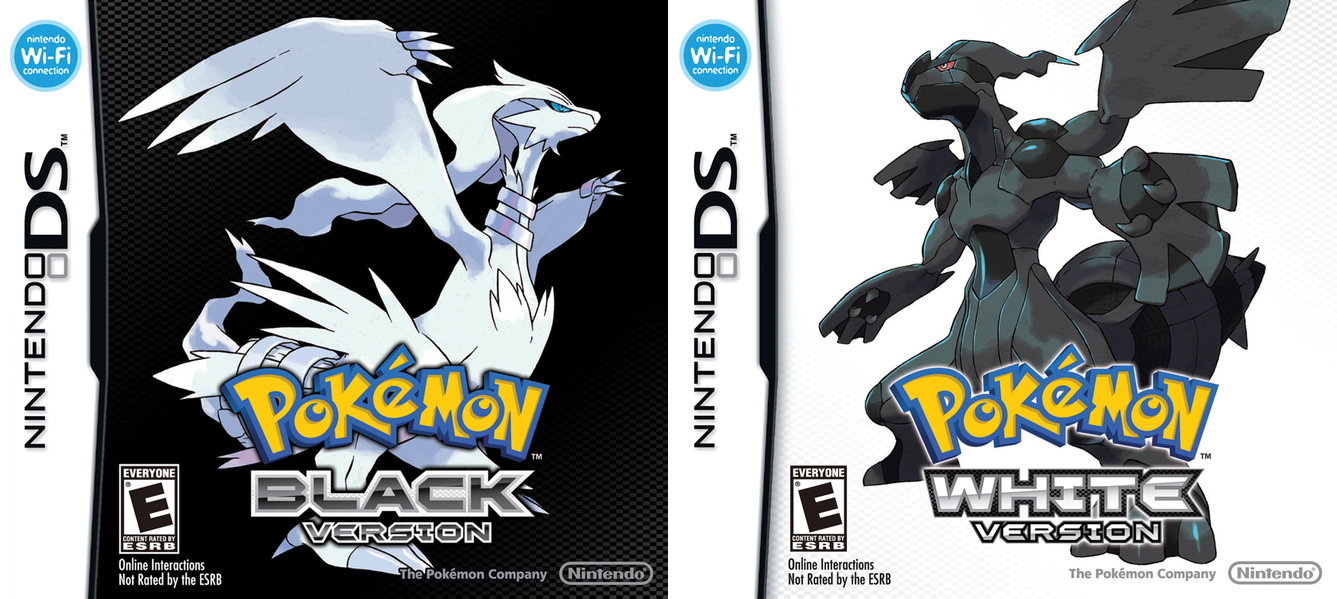
Players take the role of a young Trainer, either Hilbert or Hilda, who travels across the Unova region. Unova draws on New York City, and its central metropolis, Castelia City, borrows from that city’s skyscrapers, while Skyarrow Bridge takes cues from the Brooklyn Bridge. The journey starts with a choice of Snivy, Tepig, or Oshawott from Professor Juniper, and the friends Cheren and Bianca act as rivals. Along the way, the Trainer opposes Team Plasma, a group led by N that wants people to free their Pokémon. Reshiram is the cover Pokémon of Black, and Zekrom is the cover Pokémon of White.
Exploration happens from an overhead view, and battles are turn based. A Trainer can keep six Pokémon in the party at once, with others stored in PCs at Pokémon Centers, and each Pokémon knows up to four moves. Defeating the eight Gym Leaders earns the Badges needed to take on the Elite Four and the Champion at the Pokémon League. New additions include 156 previously unseen Pokémon, Triple Battles and Rotation Battles, fully animated battle sprites, and seasons that change every month and alter some areas.
Both versions share most of the story, but trading between them is required to fill the Pokédex. The C-Gear on the lower screen manages infrared and wireless play, covering trades, battles, video chat, and a Random Matchup option. Other activities include Pokémon Musicals, the Battle Subway, and the Royal Unova cruise ship. The Pokémon Dream World linked the games to the Pokémon Global Link website, though the online services closed in January 2014. Black 2 and White 2, sequels for the Nintendo DS, followed in 2012.
Junichi Masuda directed the games and also helped compose the music. The Pokémon Company announced the project in January 2010, and the titles were revealed that April. Masuda chose to fill the main adventure with only new Pokémon, aiming to give returning players the sense of a fresh start. Critics responded well, producing a Metacritic score of 87, and Famitsu gave a perfect 40 out of 40. The games sold more than 2.6 million copies in Japan over their first two days, and combined sales reached 15.64 million by September 2017.
There is currently no review for this game.
